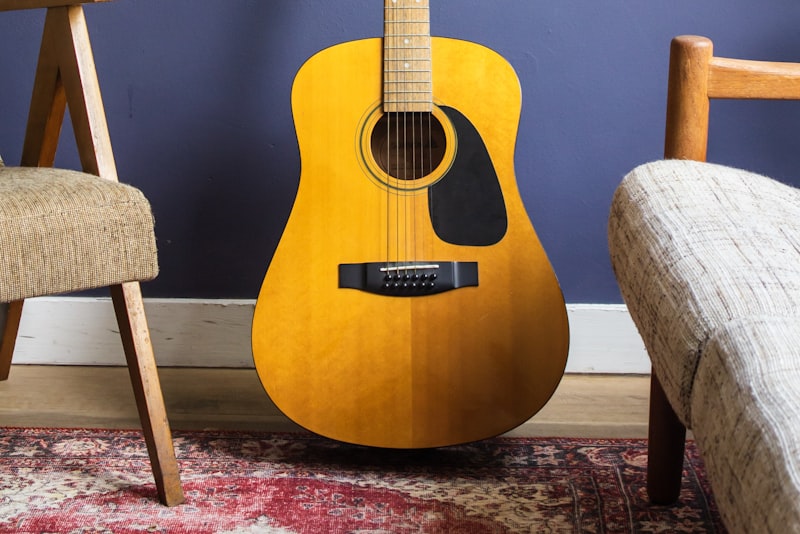
An out-of-tune guitar is the quiet reason a lot of beginners give up. You learn a chord, you play it, and it sounds wrong — not because your fingers are in the wrong place, but because the strings themselves are singing the wrong notes. No amount of practice fixes that. Tuning does.
The happy news is that tuning is a two-minute job once you know how, and modern tools make it almost foolproof. Learn to do it and every chord you play from then on will actually sound the way it's supposed to. It's the most important habit you'll build in your first week.
What "in tune" actually means#
Standard guitar tuning gives each of the six strings a specific note. From the thickest, lowest string to the thinnest, highest one, those notes are:
- 6th string (thickest): E
- 5th string: A
- 4th string: D
- 3rd string: G
- 2nd string: B
- 1st string (thinnest): E
That's the sequence E-A-D-G-B-E, and it's worth memorising early, because nearly every song, chord chart, and lesson you'll meet assumes your guitar is set up this way. People invent little phrases to remember it — plenty of players use something like "Eddie Ate Dynamite, Good Bye Eddie" — but any sentence that sticks in your head will do.
Tuning simply means adjusting each string until it produces its correct note. You do that by turning the tuning pegs at the head of the guitar, which tightens the string to raise its pitch or loosens it to lower it. Tighter and thinner means higher; looser and thicker means lower. That's the whole physics of it.
The easy way: a clip-on tuner or app#
For a beginner, the simplest and most reliable method is a tuner that listens to the string and tells you what to do. There are two common kinds, and both are excellent.
A clip-on tuner clamps onto the head of your guitar and senses the vibration of the wood, which means it works even in a noisy room. A tuning app on your phone uses the microphone to hear the string. Either one shows you the note you're playing and whether you're too low (flat) or too high (sharp), usually with a needle or a light that turns green when you've nailed it.
The routine is the same with both:
- Pluck one string and let it ring clearly.
- Look at what note the tuner detects.
- If it's below the target note, turn the peg to tighten the string slowly.
- Watch the display creep toward the right note and stop when it reads correct.
- Move to the next string and repeat.
Turn the pegs slowly and in small amounts — a little goes a long way, and yanking a string up too fast is how strings snap. Pluck again after each small turn so the tuner has a fresh note to read. Work through all six strings in order and you're done.
Always tune up to the note, not down to it. If a string is too high, loosen it below the target first, then tighten back up into pitch. Ending on a tightening motion takes the slack out of the string and helps it hold its tuning far longer.
Tuning the guitar to itself#
Sometimes you won't have a tuner handy, and it's genuinely useful to know how to tune the guitar to itself. This method won't guarantee you're at concert pitch — the whole guitar could sit slightly high or low — but every string will be in tune relative to the others, which is exactly what you need to make chords sound right.
The common approach is the fifth-fret method. Here's the idea in plain terms:
- Press the 6th (thickest) string at the 5th fret. That note should match the open 5th string. Adjust the 5th string until they ring the same.
- Press the 5th string at the 5th fret to tune the open 4th string.
- Press the 4th string at the 5th fret to tune the open 3rd string.
- Press the 3rd string at the 4th fret — the one exception — to tune the open 2nd string.
- Press the 2nd string at the 5th fret to tune the open 1st string.
Play the fretted note and the open string together and listen. When they're out of tune you'll hear a wobble or "beating" between them; as you adjust, that wobble slows and then disappears when they match. Training your ear to hear that beating is a real skill, and it pays off for the rest of your playing life.
Why your guitar keeps drifting out#
A new player is often dismayed to find the guitar out of tune again an hour later. This is normal, and it's usually not your fault. A few things push strings around.
Brand-new strings are the biggest culprit. Fresh strings stretch as they settle, so a new set will drift flat repeatedly for the first day or two of playing. You can speed this along by gently pulling each string away from the fretboard a little and then retuning — do that a few times and they'll settle down much faster.
Temperature and humidity move things too. A guitar carried in from the cold, or left near a sunny window, will shift as the wood and strings react to the change. And simply playing hard, bending strings, or knocking the pegs will nudge things over time. None of this means anything is broken. It just means tuning is a routine, not a one-time event — check it every time you pick the guitar up.
If one particular string keeps drifting far more than the others, or refuses to hold pitch at all, that can point to something mechanical rather than normal settling — an old, worn string, a peg that needs tightening, or a string that wasn't wound onto the peg neatly. Fitting strings so they wrap cleanly down the post, with no overlapping coils, makes a real difference to how well they stay put. Most tuning stability problems trace back to strings, not to the guitar itself.
Making tuning a habit that sticks#
Tune before every practice session, without exception. It takes a couple of minutes, and it changes everything about how your playing sounds and feels. A beginner practising on an in-tune guitar hears real progress; a beginner on an out-of-tune one hears mush and slowly loses heart, often without knowing why.
So clip on a tuner, run through E-A-D-G-B-E, tune up into each note, and give the strings a gentle stretch if they're new. Once that's second nature, everything you've been building sits on solid ground — the shapes from the first guitar chords to learn will finally ring true, and when you sit down to play your first guitar song, it'll actually sound like the song you had in your head. Tuning is small, but it's the foundation the rest of your playing rests on.